The score should belong to the analyst, not the vendor.
CredScore was built to give compliance analysts a wallet risk score they can actually see through. Every signal has a written rationale, every conclusion traces back to observable on-chain activity, every decision posture is defensible in a review.
Where "CredScore" came from
The name borrows from the way personal credit scores work. A single number, controlled by a third party, used by lenders to decide whether someone is a risk. The reasoning was hidden. There was no way to argue with it.
The structural problem stuck. A third party owns the number that defines you, and you have to live with whatever they produce.
Crypto compliance analysts are in the same position. They open dashboards from Chainalysis, Elliptic, and TRM Labs and receive an opaque risk score on a wallet they're being paid to defend. The reasoning is vendor-internal. The methodology is proprietary. The analyst is expected to act on the output without being able to argue with it.
CredScore is named for the inversion. The score belongs to the analyst. Every signal is readable. Every conclusion is defensible. The decision and its rationale land in the same view, in under 15 seconds.
Built outside the incumbent tooling
The incumbents (Chainalysis, Elliptic, TRM) built tools whose business model depends on customers trusting the score. CredScore inverts that. Every output traces back to specific on-chain signals an analyst can see, question, and document.
What the product is
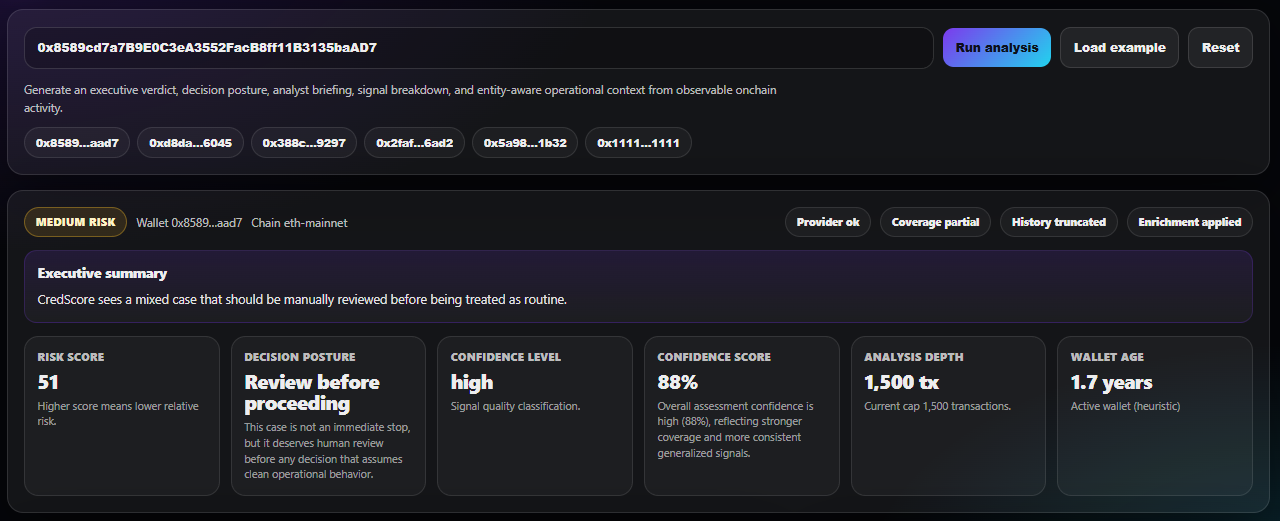
A deterministic wallet risk engine for compliance teams, AML investigators, and crypto-native firms. Paste a wallet, get a 0-100 score with a written rationale, in under 15 seconds.
How it's built
Deterministic scoring logic. No machine learning. No black boxes. Six chains supported today: Ethereum, Tron, Base, Arbitrum, Optimism, and Polygon. Every score is something an analyst can defend in a review.
Behavior over labels
Incumbent products score the present state of a wallet. CredScore scores the on-chain record. The verdict reflects what the wallet did, not whether it currently sits on a list. Three case studies test the design choice on real attacker wallets across opposite extremes: an 8-day wallet with no labels, a 15-month-dormant wallet that returned the money, and the largest hack in history.
Never finished. Always revised.
The engine is treated the way a designer treats a chair. It's never finished. It's always being revised. The threats change, the chains change, the laundering patterns change. A risk scoring engine that hasn't been updated in six months is one that's already wrong about something.
Small fixes ship continuously. Larger changes ship in regular monthly cycles. Every analyst who flags where the engine got it wrong shapes the next revision through the feedback panel on every briefing in the desk.
Compliance analysts, investigators, and anyone who has to make a call on a wallet.
Compliance analysts at smaller shops without enterprise contracts. AML consultants running their own books. Trust and safety teams at crypto-native firms. On-chain investigators chasing a hack. Lenders looking at a borrower's wallet before extending credit. Anyone who needs a fast, explainable read on wallet behavior and can't get one from the tools they currently have access to.
If that's you, your first wallet analysis is free. Solo Analyst access is $99 a month, no contract. Teams and larger workflows get a tailored Business arrangement. The fastest way to influence what gets built next is to use it and tell me where it falls short.
Get in touch.
The fastest way to shape what CredScore does next is to use it and send feedback on where the output is sharp or where it falls short.